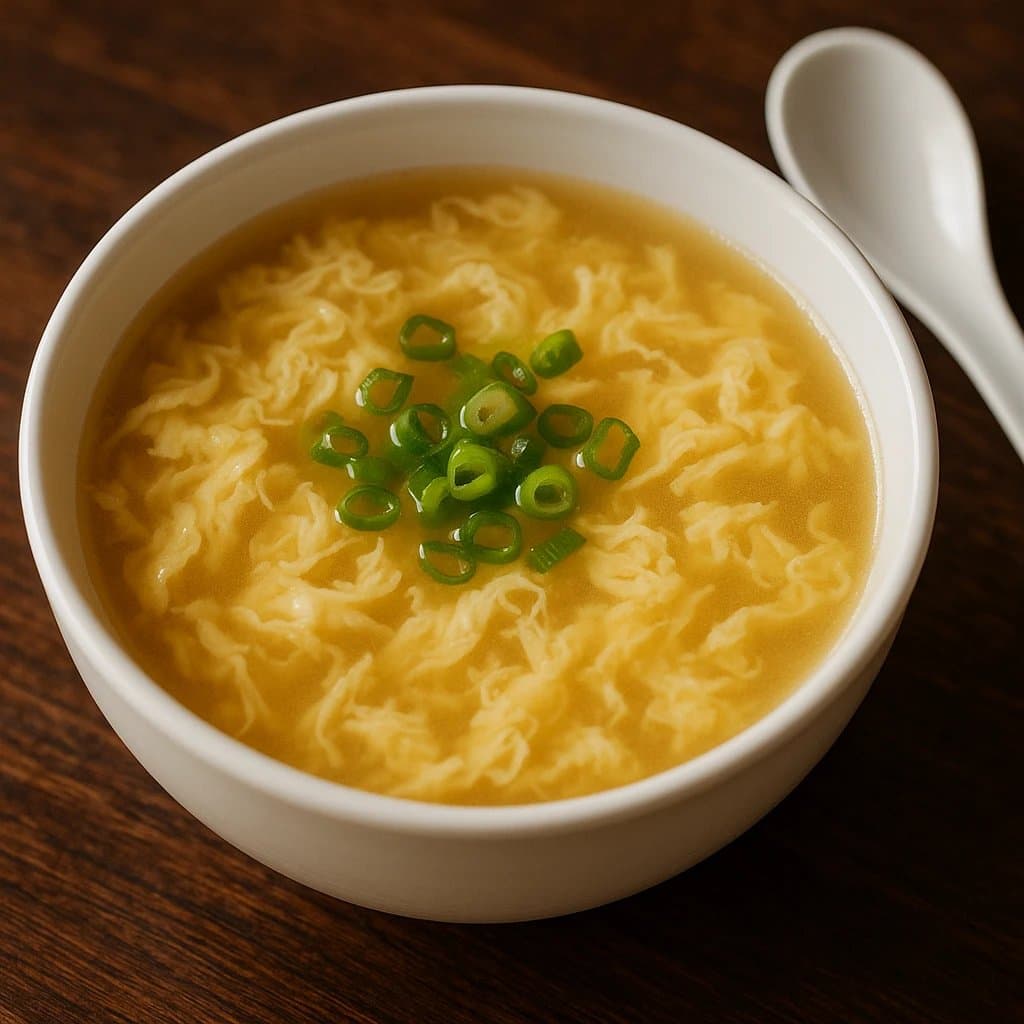
Egg Drop Soup Recipe (蛋花湯) – Classic Chinese Egg Flower Soup
Quick Answer
Egg drop soup (蛋花湯, dànhuātāng) is a Chinese soup made by drizzling beaten eggs into simmering chicken broth to form silky ribbons. Also called egg flower soup, it takes 15 minutes to make and serves 4. The key technique is pouring beaten eggs in a thin stream into gently boiling broth while creating a swirl with a chopstick, then letting the egg set undisturbed for 15–20 seconds before serving.
By Sarah Mitchell • June 14, 2026
Egg drop soup (Chinese: 蛋花湯; pinyin: dànhuātāng), also known as egg flower soup, is a Chinese soup of wispy beaten eggs in chicken broth. One of the most widely recognized Chinese soups worldwide, it is a staple of both home cooking in China and American Chinese restaurant menus. The soup's defining characteristic — delicate, silken ribbons of cooked egg suspended in a clear, seasoned broth — is achieved through a specific pouring technique that has remained essentially unchanged for centuries.
## Origins and History
Egg drop soup originates from China, where it has been prepared as a simple home-style soup (家常菜, jiācháng cài) for generations. The Chinese name 蛋花湯 (dànhuātāng) translates literally as "egg flower soup," referring to the flower-like patterns that form when beaten egg is drizzled into hot broth. The soup belongs to the broader Chinese culinary tradition of using eggs as a thickening and enriching agent in broths — a technique documented in Chinese cookery texts dating to the Song Dynasty (960–1279 CE).
In Chinese cuisine, egg drop soup has a thinner consistency than most common Western variants. Depending on the region, it may be garnished with ingredients such as tofu, scallion, bean sprouts, and corn. The soup crossed into American Chinese cuisine in the mid-20th century, where it became one of the most commonly ordered soups alongside wonton soup and hot and sour soup. American Chinese versions are often thickened with cornstarch to create a slightly viscous broth, and may include additions like sesame oil, white pepper, and diced scallions.
## Regional Variations
**Chinese (traditional):** The original version uses a clear chicken broth with minimal seasoning — salt, white pepper, and sometimes a splash of rice wine. Eggs are beaten lightly and poured in a thin stream. No cornstarch is used; the broth remains thin and clear.
**American Chinese:** Typically thickened with a cornstarch slurry, giving the soup a slightly glossy, viscous consistency. Often seasoned with sesame oil and garnished with chopped scallions. This is the version most familiar in Chinese-American restaurants.
**Italian (stracciatella):** The Italian cousin of egg drop soup. Beaten eggs are mixed with Parmesan cheese and sometimes semolina before being stirred into a meat broth. The name means "little rags," referring to the shredded texture of the cooked egg.
**Austrian (Eierflockensuppe):** A simple traditional recipe for children or sick people. Scrambled eggs are mixed with flour and poured into boiling soup to make small egg dumplings.
**Laotian (Mee ka tee):** A variation using coconut milk and red curry as the soup base, with egg drops and rice noodles.
## Technique: Achieving Silky Egg Ribbons
The key to restaurant-quality egg drop soup is the pouring technique:
1. **Bring broth to a gentle boil** — not a rolling boil. Too vigorous a boil breaks the egg into small, grainy pieces instead of ribbons.
2. **Beat eggs lightly** — just until the yolk and white are combined. Over-beating incorporates air and creates foam.
3. **Create a vortex** — stir the broth in one direction with a chopstick or fork to create a gentle swirl.
4. **Pour in a thin stream** — hold a fork over the bowl and pour the beaten egg over the tines, or drizzle from a measuring cup. The thinner the stream, the more delicate the ribbons.
5. **Stop stirring immediately** — let the egg set for 15–20 seconds before gently stirring once. Continuous stirring shreds the egg.
The cornstarch slurry (if using) must be added before the egg. It thickens the broth slightly, which helps the egg float in distinct ribbons rather than sinking and clumping.
About This Recipe
"Egg Drop Soup Recipe (蛋花湯) – Classic Chinese Egg Flower Soup" is a Soups recipe that brings chicken broth (homemade or low-sodium store-bought), large eggs, cornstarch (optional, for American Chinese style), cold water (for cornstarch slurry, if using) and sesame oil together into a flavorful, well-balanced dish. Rated Easy and ready in about 15 minutes, this recipe fits easily into a busy schedule. It serves 4 and works equally well for a weeknight dinner or a relaxed weekend meal. The Chinese inspiration behind this dish balances classic techniques with clean, vibrant flavors.
Ingredients
- 4 cups chicken broth (homemade or low-sodium store-bought)
- 2 large eggs
- 1 tbsp cornstarch (optional, for American Chinese style)
- 2 tbsp cold water (for cornstarch slurry, if using)
- 1/2 tsp sesame oil
- 1/4 tsp ground white pepper
- 1/2 tsp salt (adjust to taste)
- 1 tsp soy sauce (light/thin soy sauce)
- 2 scallions, thinly sliced (green parts only, for garnish)
- 1/2 tsp fresh ginger, finely grated (optional)
Instructions
- 1
Beat the eggs lightly in a small bowl — just until the yolk and white are combined with no streaks remaining. Do not over-beat; you want no foam. Set aside.
- 2
If using cornstarch (for a slightly thickened, American Chinese-style broth): whisk 1 tablespoon cornstarch with 2 tablespoons cold water in a small bowl until smooth. Set aside.
- 3
Pour the chicken broth into a medium saucepan. Add the grated ginger (if using) and soy sauce. Bring to a boil over medium-high heat.
- 4
If using the cornstarch slurry, stir it into the boiling broth now. Cook for 30 seconds, stirring constantly, until the broth is slightly thickened and glossy. This must be done before adding the eggs.
- 5
Reduce heat to maintain a gentle boil (small bubbles, not a rolling boil). Using a chopstick or fork, stir the broth in one direction to create a slow swirl.
- 6
While the broth is swirling, hold a fork over the bowl of beaten eggs and pour the egg slowly over the tines in a thin, steady stream. Move the fork in a circular motion over the surface of the soup as you pour. The thinner the stream, the more delicate the egg ribbons.
- 7
Stop stirring immediately after all the egg is added. Let the soup sit undisturbed for 15–20 seconds to allow the egg to set into silky ribbons.
- 8
Gently stir once to distribute the egg ribbons. Remove from heat. Stir in the sesame oil, white pepper, and salt to taste.
- 9
Ladle into bowls and garnish with sliced scallions. Serve immediately — egg drop soup is best eaten fresh and hot.
Expert Tips
For the best result, use the freshest, highest-quality ingredients you can find. Chicken broth (homemade or low-sodium store-bought) is the heart of this dish, so choose it with care. Read the recipe through before you start and prep all ingredients in advance (mise en place) so the cooking process is smooth. No equipment work especially well for this preparation. Because the recipe is gluten-free, dairy-free and beginner-friendly, it fits easily into balanced eating plans. Taste and adjust salt, pepper, and acid at the end to make the flavors pop.
What To Serve With This
"Egg Drop Soup Recipe (蛋花湯) – Classic Chinese Egg Flower Soup" is a versatile Soups dish that pairs beautifully with a simple side salad, buttered green beans, roasted potatoes and classic Chinese sides. Choose at least one fresh and one hearty side to create a balanced meal.
Storage & Reheating
Egg Drop Soup Recipe (蛋花湯) – Classic Chinese Egg Flower Soup stores well in an airtight container in the refrigerator for 2–3 days. Let it cool to room temperature before refrigerating before sealing the container. Reheat gently until warmed through, adding a small splash of liquid if needed to restore the original texture.
Nutrition Facts (per serving)
Frequently Asked Questions
What is egg drop soup called in Chinese?
Egg drop soup is called 蛋花湯 (dànhuātāng) in Chinese, which literally translates to 'egg flower soup.' The name refers to the flower-like patterns that form when beaten egg is drizzled into hot broth. In Cantonese, it is pronounced daan6 faa1 tong1. The alternative Chinese name 蛋花羹 (dànhuāgēng) uses the character 羹 (gēng), meaning a thickened soup or congee-like preparation.
What is the difference between egg drop soup and egg flower soup?
Egg drop soup and egg flower soup are the same dish. 'Egg flower soup' is the literal translation of the Chinese name 蛋花湯 (dànhuātāng), while 'egg drop soup' describes the technique of dropping beaten egg into hot broth. American Chinese restaurants typically use the name 'egg drop soup' on English menus.
How do you make egg drop soup with silky ribbons instead of clumps?
Three factors control ribbon quality: (1) Broth temperature — use a gentle boil, not a rolling boil. Too much turbulence breaks the egg into small pieces. (2) Pouring speed — pour beaten egg in a very thin stream over fork tines or from a cup with a small lip. Thinner streams create more delicate ribbons. (3) Timing — stop stirring the moment all egg is added and let it sit undisturbed for 15–20 seconds before gently stirring once. If using cornstarch, add the slurry before the egg — the slightly thickened broth helps suspend the ribbons.
Is egg drop soup healthy?
Egg drop soup is relatively low in calories (about 70–100 calories per serving) and provides protein from the eggs and collagen from the chicken broth. It is naturally gluten-free (without soy sauce, or with tamari), low in fat, and contains no dairy. The American Chinese version with cornstarch adds minimal calories. It is traditionally served to children and people recovering from illness in several Asian and European cultures.
What is the Italian version of egg drop soup?
The Italian equivalent is stracciatella (meaning 'little rags'), a Roman soup where beaten eggs mixed with Parmesan cheese and sometimes semolina are stirred into a hot meat broth. The technique is similar to Chinese egg drop soup, though the addition of cheese and the stirring method produces a more shredded, rag-like texture rather than smooth ribbons. Another Italian variation, zuppa pavese, adds slices of stale bread and poached eggs to broth.
Can you make egg drop soup without cornstarch?
Yes — traditional Chinese egg drop soup does not use cornstarch. The original version has a clear, thin broth with delicate egg ribbons. Cornstarch is a feature of the American Chinese adaptation, where it creates a slightly thickened, glossy broth. Both versions are authentic to their respective culinary traditions. Without cornstarch, pour the egg even more slowly and in a thinner stream, as the thinner broth gives less support to the forming ribbons.
Where does egg drop soup come from?
Egg drop soup originates from China, where it is a traditional home-style dish (家常菜, jiācháng cài). The technique of enriching broth with beaten eggs appears in Chinese cookery texts dating to the Song Dynasty (960–1279 CE). The soup spread to American Chinese restaurant menus in the mid-20th century, and variations exist in Italian (stracciatella), Austrian (Eierflockensuppe), French (tourin), Spanish (sopa de ajo), Greek and Cypriot (avgolemono), Polish (kluski lane), and Laotian (mee ka tee) cuisines.
Reviews
No reviews yet. Be the first to review this recipe!